Sydney McLaughlin-Levrone blazes 47.78 to win the women’s 400m world title in Tokyo - No. 2 all-time
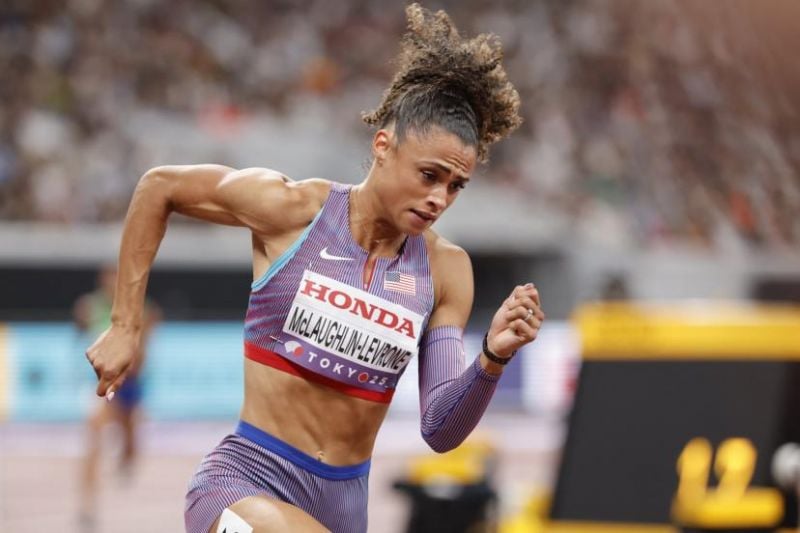
Sydney McLaughlin-Levrone, the world record holder in the 400m hurdles, delivered a historic performance to win the women’s 400 metres at the World Athletics Championships in Tokyo, clocking 47.78 — the second-fastest time in history. Only Germany’s Marita Koch has run faster, setting the long-standing world record of 47.60 at the 1985 World Cup in Canberra.
- View World Athletics Championships All Results
- View World Athletics Championships worldwide TV and Streaming Details
The American shattered the championship record of 47.99 set by Jarmila Kratochvílová at the inaugural World Championships in Helsinki in 1983. The Tokyo Olympic champion in the 400m hurdles (51.46 WR in 2021) returned to the same stadium to write another golden chapter in her career.
Just two days earlier, McLaughlin-Levrone had broken Sanya Richards-Ross’s American record in the semifinals with 48.29, signaling her blistering form.
Sydney McLaughlin-Levrone: “It’s amazing. It’s an honour. I knew there were a lot of people doubting me with making the switch from 400 metres hurdles to the flat 400 metres. I had faith in my training. I knew I had it in me to run so fast — it was just a matter of time. It definitely helped having Marileidy Paulino in the outer lane where I could see her. My coach told me to get out of the blocks as fast as possible. There are so many people who have been there for me — my husband, my coach Bob Kersee, Jackie Joyner-Kersee, so many others.”
McLaughlin-Levrone held off Marileidy Paulino, who smashed her personal best with 47.98, moving to third on the world all-time list behind Koch and McLaughlin-Levrone. It marked the first time in history that two women broke the 48-second barrier in the same race, with McLaughlin-Levrone also breaking Paulino’s continental record.
Salwa Eid Naser, this year’s Diamond League champion in Zurich, claimed bronze in 48.19, just 0.05 shy of her PB.
All eight finalists broke 50 seconds, underlining the depth of this historic final. Natalia Bukowiecka and Amber Anning finished fourth and fifth with season’s bests of 49.27 and 49.36. Roxana Gómez clocked a national record 49.48 in sixth. Henriette Jæger, the European U23 champion, took seventh in 49.74, and Nickisha Pryce, the 2024 NCAA champion, placed eighth in 49.97.
Women’s 400m Final — Official Results
- Sydney McLaughlin-Levrone (USA) — 47.78 CR, #2 all-time
- Marileidy Paulino (DOM) — 47.98 NR, #3 all-time performance
- Salwa Eid Naser (BRN) — 48.19
- Natalia Bukowiecka (POL) — 49.27
- Amber Anning (GBR) — 49.36 SB
- Roxana Gómez (CUB) — 49.48
- Henriette Jæger (NOR) — 49.74
- Nickisha Pryce (JAM) — 49.97
Key Stats & All-Time Context
Top 5 All-Time Women’s 400m Performances
- Marita Koch (GDR) — 47.60 (Canberra 1985)
- Sydney McLaughlin-Levrone (USA) — 47.78 (Tokyo 2025)
- Marileidy Paulino (DOM) — 47.98 (Tokyo 2025)
- Jarmila Kratochvílová (TCH) — 47.99 (Helsinki 1983)
- Salwa Eid Naser (BRN) — 48.14 (Doha 2019)
Other highlights from the Tokyo final
- McLaughlin-Levrone broke the Championship Record (47.99, Kratochvílová 1983).
- Paulino set a Dominican national record and became the third-fastest woman in history.
- Naser ran 48.19, her second-fastest time ever, returning to global podium form.
- All eight finalists ran sub-50 seconds, making this one of the deepest 400m finals in history.
McLaughlin-Levrone is expected to return to the track later this week for the 4x400m relay, where the United States will be strong favourites for gold — and may even challenge the championship record if she anchors the team.
Men’s 400 metres final:
Botswana’s 21-year-old Colleen Kebinatshipi won the men’s 400 metres gold medal setting a world seasonal lead and a national record of 43.53. Kebinatshipi became Botswana’ first ever world champion in the 400 metres. He had already broken the 44 seconds barrier with 43.61 in the semifinal. The Botswanan athlete added this title to his collection that includes the Olympic silver medal in the 4x400 relay in Paris 2024 alongside his teammates Bayapo Ndori and Letsile Tebogo.
Collen Kebinatshipi: “This is my first title and it feels crazy. After the semifinal I really started to believe in myself and to think that my new chapter. Until the semifinal I have been doubting myself. I had my struggles, but in the final I had no fear. I told myself to go out fast and do better in the semifinals. The medal was just a bonus. Being able to run the national record and a world lead is fantastic. I still have the relay. We are a strong contender for gold. Having three athletes from Botswana running this final show we are growing”.
Jereem Richards from Trinidad and Tobago won the silver medal improving the national record to 43.72.
Botswana’s Bayapo Ndori came through to win the bronze medal in a seasonal best of 44.20. Rusheen McDonald from Jamaica finished fourth in 44.28.
Zakhiti Nene from South Africa, who entered these championships with a world lead of 43.76, finished fifth in 44.55 ahead of Japanese record holder Joseph Nakashima, who took sixth place in 44.62. Jacory Patterson, this year’s Diamond League winner, finished seventh in 44.70. Lee Bhekempilo Eppie, the third Botswanan athlete in the field, rounded out the top-eight in 44.77.
Women’s triple jump:
Leyanis Perez Hernandez leapt to 14.94m twice in the fourth and sixth round to win her second world title in the women’s triple jump. The Cuban athlete added one centimetre to her previous world leading mark of 14.93m set when she won the world indoor title in Nanjing.
Leyanis Perez Hernandez: “This is an incredible year for me with both the world indoor and outdoor gold. It was a special night for Cuban women tonight. I will tell my fellow Cuban women to keep fighting. I have fallen and bounced back. There’s a lot of sacrifice, but nothing beats the satisfaction of improving oneself and winning a medal.”
Olympic champion Thea Lafond from Dominica improved her seasonal best to 14.89m in the sixth round to win the silver medal. Lafond becomes the first athlete from her country to win a world championships medal.
Yulimar Rojas from Venezuela, Olympic champion in Tokyo 2021 and world record holder, leapt to 14.76m to win the world bronze medal in her first competition since she was sidelined by an Achilles tendon for the entire 2024 season and most of 2025.
Yulimar Rojas: “I’m very emotional, with mixed feelings. It was a blessing for me to be back in the World Championships final after the past two years were so difficult. I’m very proud of that and it’s a victory for me. I’m back on the podium but I wanted more. I feel deep inside that I could have done way better. But this is sport… you have to go through hard times and show you can come back. That’s what I did and it means a lot.”
Liadagmis Povea from Cuba finished fourth with with 14.72m. Olympic silver medallist Shanieka Ricketts from Jamaica rounded out the top five with 14.56m.
Men’s javelin throw final:
Trinidad and Tobago’s Keshorn Walcott won the second global title of his career in the men’s javelin throw with 88.16m thirteen years after winning the Olympic gold medal in London 2012.
Walcott took the lead in the second round with 87.83m and improved to 88.16m. Two-time world champion Anderson Peters from Grenada won the silver medal with a second-round throw with 87.38m. Curtis Thompson from the USA won a surprising bronze medal with 86.67m. World leader Julian Weber had to settle with fifth place with 86.11m. Defending champion Neeraj Chopra from India placed eiighth with 84.03m.
Keshorn Walcott: “I have been waiting for this medal for 13 years. Olympic victory at the age of 19 was amazing. I could never beat it, but in every world championships I hoped I was ready. I have been fighting for this but I was always off the podium. I even thought that these championships are not my competition, but I never gave up. If had given up, I would not be here. I knew that the competition would be tough. We were expecting a lot more throws, but at the end of the day the best throw wins”.
Men’s 200 metres semifinal:
Three-time world champion Noah Lyles set a world leading of 19.51, the fastest semifinal in the history of the World Championships. British record holder Zharnel Hughes and Sinesipho Dambile dipped under the 20 seconds barrier clocking 19.95 and 19.97 respectively.
Noah Lyles: “I surprised myself. I am going to put on a whole race in the final. The goal was to run the bend well and finish first. I knew I was running fast when I exited the curve but I did not expect 19.51. I was expecting 19.60 or 19.70.
Jamaica’s Brian Levell won the second semifinal in 19.78 ahead of Olympic champion Letsile Tebogo from Botswana (19.95). Courtney Lindsey finished third in 20.30 ahead of world under 20 silver medallist and Australian record holder Gout Gout (20.36).
Kenneth Bednarek claimed the win in the first semifinal in 19.86. Alexander Ogando also dipped under the 20 seconds to finish second in 19.95 ahead of Zimbabwe’s Makanakaishe Charamba (20.03) and South Africa’s Wayde Van Niekerk (20.12).
Women’s 200 metres semifinal:
Double world champion Sherika Jackson set a seasonal best of 21.99 to win the first semifinal. Amy Hunt qualified for the final in second place improving her PB to 22.08. This year’s Diamond League champion Brittany Brown finished third equalling her seasonal best with 22.13 beating Anthonique Strachan from Bahamas (22.48).
Anavia Battle won the third semifinal in 22.09. Marie Josée Ta Lou set a seasonal best of 22.17 to take the second automatic qualifying spot.
Melissa Jefferson Wooden, 100 metres champion in Tokyo, won the third semifinal easily in 22.00 slowing down in the final metres. Dina Asher Smith got through to the final in second place in 22.21.
Melissa Jefferson Wooden: “Everything is lining up the way it was supposed to. I came today with one goal. That was to run the bend the way my coach wanted me to and to save as much energy as possible. Recovery takes me a bit of time. I am taking it day by day. To be able to show up today and and perform well is great. It’s really important for me to win the title. This is what I have been working on the whole year”.
Men’s 800 metres semifinal:
Defending champion Marco Arop from Canada won a very close race in the first semifinal in 1:45.09 edging Algeria’s Djamel Sedjati with the same time.
Ireland’s Cian McPhillips won the second semifinal improving the national record to 1:43.18. Max Burgin from Great Britain finished second in 1:43.37 to qualify for the semifinal. Burgin ran the overall third fastest time. Donovan Brazier placed third in 1:43.82 beating Italy’s Francesco Pernici, who improved his PB to 1:43.84.
Spanish record holder Mohamed Attaoui also clocked 1:43.18 to win the third semifinal ahead of Olympic champion Emmanuel Wanyonyi, who qualified for the final in second place in 1:43.47. Navasky Anderson from Jamaica improved the national record to 1:43.70 to set the fastest non-automatic qualifying time. Tshepiso Maselela from Botswana achieved the second fastest non-automatic spot with 1:43.80.
Women’s 5000 metres heats:
Olympic champion and world record holder Beatrice Chebet won the women’s 5000 metres in 14:45.59 ahead of Olympic and world silver medallist Nadia Battlocetti (14:46.36) in a head-to-head race between the top-two finishers of the 10000 metres. Shelby Houliahn finished third in 14:46.52.
Gudaf Tsegay from Ethiopia won the second heat in 14:56.46. Olympic and world champion Faith Kipyegon placed second with a seasonal best of 14:56.71 beating Rose Davies (14:56.83).
Women’s 800 metres heats:
Kenya’s Lilian Odira led the women’s 800 metres first round when she won the fifth heat in 1:57.86 ahead of Daily Cooper Gaspar from Cuba (1:58.16) and Worknesh Mesele from Ethiopia (1:58.46). Jemma Reekie finished fifth in 1:59.35 and did not advance to the semifinal.
Olympic and European champion Keely Hodgkinson eased into the semifinal with a comfortable win in the first heat of the women’s 800 metres in 1:59.79. Hodgkinson returned to the Tokyo National Stadium where she won the silver medal in 2021 at the age of 19. Assia Raziki from Morocco took second place in 1:59.82 ahead of France’ s Clara Liberman (2:00.17).
Keely Hodgkinson: “I just really wanted to enjoy being back in the stadium. It's so nice to be here. It wasn't pretty or dominant, but nice to be safely through. It's been a long week waiting around”.
Anais Bourgoin took a close win in the second heat in 1:58.43 edging 2023 world champion Mary Moraa (1:58.44). Gabriela Gajanova from Slovakia finished third in 2:00.44.
Olympic silver medallist Tsige Duguma won the third heat in 2:01.53 beating USA’s Maggi Congdon (2:01.74) and World University Games champion Eloisa Coiro from Italy (2:01.86).
This year’s Diamond League champion Audrey Werro from Switzerland won the fourth heat in 1:58.43 sharing the same time as second placer Sage Hurta Klecker.
Georgia Hunter Bell from Great Britain won the sixth heat in 1:58.82. Gabija Galvydite from Lithuania and Claudia Hollingsworth took the two automatic qualifying spots with 1:58.96 and 1:59.06.
Natoya Goule Toppin from Jamaica won the seventh heat in 1:59.66 ahead of Botswana’s Oratile Nowe (2:00.09).
Women’s high jump qualifying round:
Morgan Lake, Nicola Olyslagers, Yaroslava Mahuchik, Eleanor Patterson, Angelina Topic,Michaela Hruba and Yulia Levchenko cleared all heights until 1.92 in their first attempts to lead the women’s high jump qualifying round. Vashti Cunningham did not get through to the final.