Dinki and Yimer Win Frankfurt Marathon as Dörfel Shines With 2:20:46 Debut
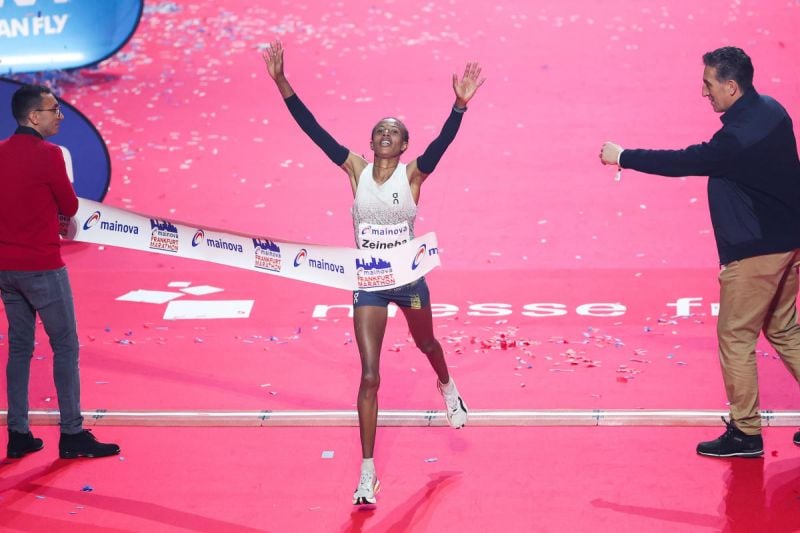
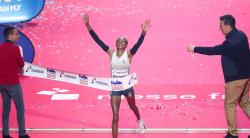
Ethiopia’s Jirata Dinki and Zeineba Yimer won the 43rd Mainova Frankfurt Marathon in 2:05:26 and 2:19:45 respectively, while Germany’s Blanka Dörfel delivered a remarkable marathon debut, finishing second in 2:20:46.
Despite wet and windy conditions for much of the race, the 24-year-old became the second-fastest German woman and eighth-fastest European woman in marathon history. Ethiopia’s Beriha Gebreslasie completed the women’s podium in 2:22:46.
In the men’s race, Germany’s European champion Amanal Petros finished second in 2:05:46, becoming the first German man to reach the Frankfurt podium in more than 25 years. Kenya’s Benard Biwott, the 2024 winner, placed third in 2:06:23. Germany’s Richard Ringer and Samuel Fitwi finished fifth and seventh in 2:07:07 and 2:08:57 respectively.
A record 19,720 runners from 128 nations entered this year’s event, which also marked Jo Schindler’s final edition as race director after 25 years.
“I will continue to be available as an adviser. We have found a fantastic strategic partner in London Marathon Events, and in Holger Kranz we have a successor who is ideally placed to take the event to further heights,” said Schindler.
Women’s Race: Yimer Takes Victory as Dörfel Makes Her Mark
Pre-race favourite Zeineba Yimer and debutant Blanka Dörfel took centre stage in the women’s race.
Yimer, 28, led from the outset, initially accompanied by fellow Ethiopian Siranesh Yirga. After 30 kilometres, Yirga could no longer maintain the pace, leaving Yimer out in front. Although she struggled in the closing kilometres, Yimer held on to win in 2:19:45, the sixth-fastest women’s time in the event’s history.
“I was hoping I would win. The weather was not on our side. The rain slowed me down, but I am very happy with my performance,” said Yimer.
Behind her, Dörfel produced a sensational debut. Running with a smooth, composed stride, the German emerged from a ten-woman group and passed halfway in 70:29. She then pulled away from established contenders, including Betsy Saina of the United States and Kenya’s Marion Kibor, while steadily reducing the gap to the leaders.
Dörfel moved into second place at 33 kilometres and held that position to the finish. At times, a sub-2:20 debut appeared within reach, but her eventual 2:20:46 still secured a prominent place in German and European marathon history.
“I am really happy. It is brilliant to have achieved a time of 2:20. The wet course was a challenge – I ended up with my feet in water plenty of times. I felt great right up to the half marathon mark, after that it got a little bit tougher. The last five kilometres were really hard for me. I ran without a watch as I do in training, going purely by how I feel, not by the time. It was always a bit of a mystery to me what time I could achieve. It wasn’t until I was in the Festhalle that I saw the 2:20 and realised just how fast I was. I thought the crowd was brilliant. So many people were shouting ‘Blanka, run!’ It was a brilliant day,” she said.
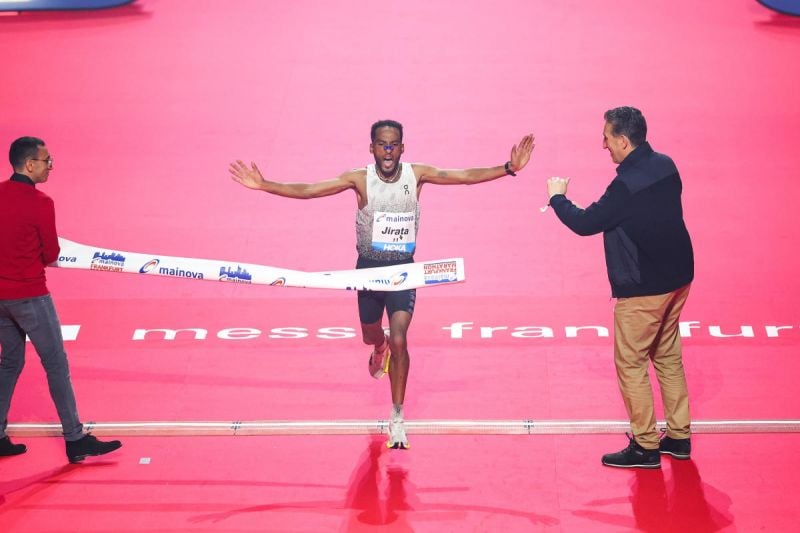
Men’s Race: Dinki Prevails in Late Battle With Petros
German record ambitions gave way to a compelling tactical contest in the men’s race.
European champion and World Championships silver medallist Amanal Petros, who holds the national record of 2:04:03, and Samuel Fitwi had targeted the mark. Richard Ringer also joined the large leading group, but the difficult weather soon put those ambitions in doubt.
The leaders passed ten kilometres in 29:55, projecting a finishing time just over 2:06, before reaching halfway in 63:01.
The decisive moves began with around ten kilometres remaining, when Petros and Biwott increased the pace and opened a small gap. Fitwi dropped back with muscle problems, while Ringer attempted to bridge the gap before gradually losing ground.
Dinki, meanwhile, worked his way into contention. The 24-year-old Ethiopian, who entered with a personal best of 2:08:18, caught the leaders at around 37 kilometres.
Petros attacked again and briefly appeared poised for victory. Biwott could not respond, but Dinki fought back before launching a decisive move of his own.
“I had not reckoned with him,” said Petros, who finally lost contact with around two kilometres remaining.
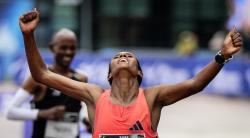
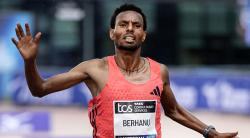
Just two and a half months after his gruelling European Championships victory, Petros could not match Dinki’s finishing pace. The Ethiopian crossed the line in 2:05:26, improving his personal best by almost three minutes and claiming the biggest victory of his career in only his third marathon.
“The weather was not ideal, so I started off more cautiously. But I was sure I would run a good race. This is a huge victory for me,” said Dinki.
Petros followed 20 seconds later in 2:05:46, recording the fastest time ever run by a German man at the Mainova Frankfurt Marathon.
“I gave it a go, but in that weather it was clear that a record was not going to happen. Then I suppose I attacked a bit too early – I will learn from that. Of course I would have liked to win, but that is how it goes in the marathon,” said Petros.